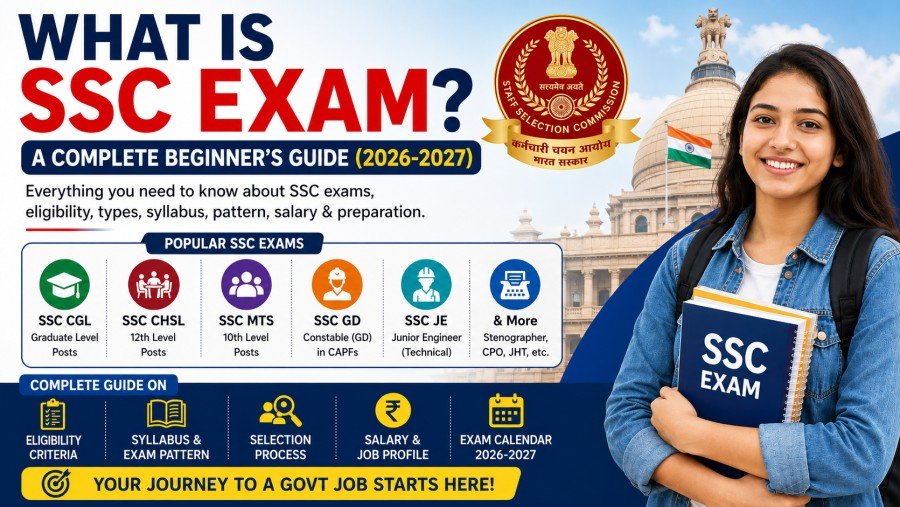
If you are preparing for a government job in India, you have probably heard about the SSC exam. The Staff Selection Commission (SSC) conducts several competitive examinations to recruit candidates for different posts in central government departments, ministries and organisations.
SSC exams are suitable for candidates with different educational qualifications, from Class 10 and Class 12 to graduation and specialised technical qualifications.
This beginner-friendly guide explains what SSC is, which exams SSC conducts, eligibility, age limit, syllabus, exam pattern, selection process, salary, and how to start preparing for SSC exams in 2026–2027.
What Is SSC?
SSC stands for Staff Selection Commission. It is a Government of India organisation responsible for conducting recruitment examinations for various posts in central government departments and offices.
SSC conducts multiple examinations every year, including SSC CGL, SSC CHSL, SSC MTS, SSC GD, SSC JE, SSC Selection Post, SSC Stenographer and SSC CPO.
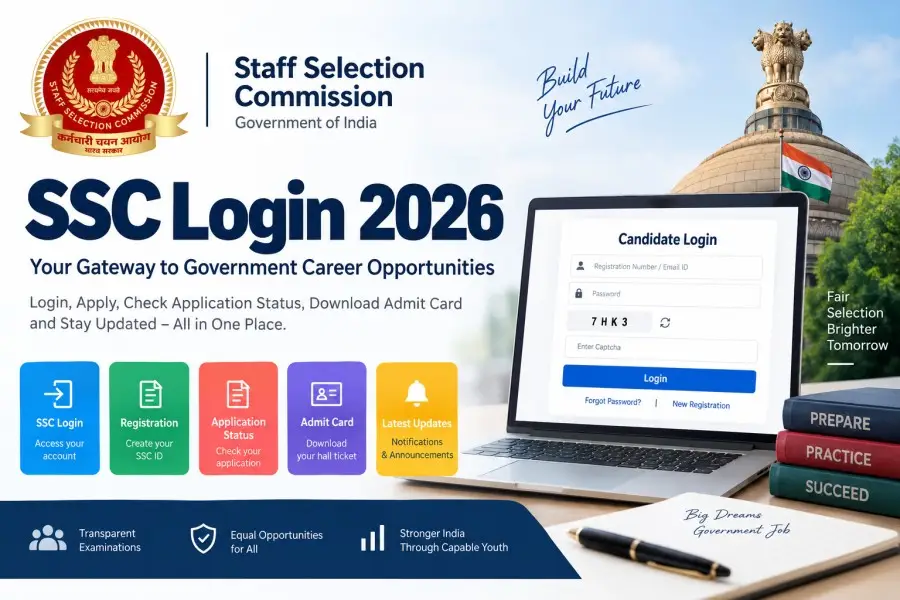
The official SSC website provides examination notifications, applications, admit cards, results, answer keys, examination calendars and other candidate services.
What Is SSC Exam?
An SSC exam is a competitive recruitment examination conducted by the Staff Selection Commission to select eligible candidates for various government posts.
The important SSC examinations include:
| SSC Exam | Basic Qualification | Major Recruitment |
|---|---|---|
| SSC CGL | Graduation | Group B & C posts |
| SSC CHSL | Class 12 | LDC, JSA, DEO and related posts |
| SSC MTS | Class 10 | Multi-Tasking Staff |
| SSC GD | Class 10 | Constable GD |
| SSC JE | Diploma/Degree in Engineering | Junior Engineer |
| SSC Stenographer | Class 12 | Stenographer Grade C & D |
| SSC CPO | Graduation | Sub-Inspector |
| SSC Selection Post | Depends on post | Various Group B & C posts |
| SSC JHT | Relevant postgraduate qualification | Hindi Translator posts |
The exact eligibility, vacancies and selection process vary by examination and notification.
Why Should You Choose SSC Exams?
SSC exams are popular among government job aspirants because they provide opportunities to work in different central government departments and organisations.
Some major advantages include:
- Central government career opportunities
- Multiple examinations every year
- Different qualification levels
- Various job profiles
- Opportunities across India
- Structured recruitment process
- Career growth and promotions
- Salary and allowances according to the applicable rules
However, candidates should remember that selection is competitive, and eligibility and vacancies vary from one examination to another.
Types of SSC Exams
1. SSC CGL
SSC Combined Graduate Level (CGL) is one of the most popular SSC examinations.
It is primarily for graduates and recruits candidates for various Group B and Group C positions in central government departments and organisations.
Depending on the post, candidates may be considered for positions such as:
- Assistant Section Officer
- Inspector
- Auditor
- Accountant
- Tax Assistant
- Sub-Inspector
- Junior Statistical Officer
- Other Group B and Group C posts
2. SSC CHSL
SSC CHSL stands for Combined Higher Secondary (10+2) Level Examination.
It is primarily aimed at candidates who have completed Class 12.
Posts may include:
- Lower Divisional Clerk (LDC)
- Junior Secretariat Assistant (JSA)
- Data Entry Operator (DEO)
The SSC’s 2026–27 calendar lists the SSC CHSL 2026 Tier-I examination for July–September 2026.
3. SSC MTS
SSC MTS stands for Multi-Tasking (Non-Technical) Staff Examination.
It is generally an entry-level SSC examination for candidates who meet the prescribed matriculation/Class 10 qualification.
The examination also includes recruitment for Havaldar positions in CBIC and CBN under the relevant notification.
The 2026–27 SSC calendar lists the MTS and Havaldar examination for September–November 2026.
4. SSC GD Constable
SSC GD is conducted for recruitment to Constable (General Duty) positions in various Central Armed Police Forces and related organisations.
The 2026–27 calendar includes Constable (GD) in CAPFs, NIA, SSF and Rifleman (GD) in Assam Rifles Examination 2027, with the computer-based examination tentatively scheduled for January–March 2027.
Candidates should check the official notification for the latest physical, medical, educational and other eligibility requirements.
5. SSC JE
SSC Junior Engineer (JE) is designed for candidates with the prescribed engineering qualification.
The examination covers areas such as:
- Civil Engineering
- Mechanical Engineering
- Electrical Engineering
The SSC 2026–27 calendar lists the Junior Engineer examination for May–June 2026.
6. SSC Stenographer
SSC conducts the Stenographer Grade C and Grade D Examination for eligible candidates with the required qualification and stenography skills.
The 2026–27 calendar lists the examination for August–September 2026.
7. SSC CPO
SSC CPO is the Sub-Inspector examination for recruitment to Sub-Inspector positions in Delhi Police and Central Armed Police Forces.
The 2026–27 calendar lists the Paper-I examination for October–November 2026.
SSC Eligibility Criteria
There is no single eligibility criterion for all SSC exams.
Eligibility depends on the examination and the specific post.
Educational Qualification
Depending on the examination, candidates may need:
- Class 10 qualification
- Class 12 qualification
- Bachelor’s degree
- Engineering diploma or degree
- Postgraduate qualification
- Specific subject or technical qualification
For example:
SSC MTS: Generally Class 10 level qualification.
SSC CHSL: Generally Class 12 level qualification.
SSC CGL: Generally a bachelor’s degree for most posts.
SSC JE: Prescribed diploma/degree in the relevant engineering discipline.
Always check the individual notification because post-specific requirements can differ.
SSC Age Limit
The age limit is different for different SSC examinations and posts.
Depending on the post, the prescribed age range may vary. There are also applicable relaxations for eligible categories according to government rules.
Therefore, do not assume that one age limit applies to every SSC examination.
Always check the latest official notification before applying.
SSC Exam Pattern
The exam pattern depends on the SSC examination.
Many SSC examinations use Computer Based Examinations (CBE), while some recruitment processes include additional stages such as skill tests, physical tests, descriptive papers or document verification.
For example, SSC CGL and CHSL have different examination structures, while SSC GD and SSC CPO include additional selection requirements depending on the post.
The official SSC website publishes the scheme of examination, syllabus and examination-specific instructions for candidates.
SSC Syllabus
For many SSC examinations, preparation commonly covers subjects such as:
1. General Intelligence and Reasoning
Important areas include:
- Analogy
- Classification
- Series
- Coding-decoding
- Blood relations
- Direction sense
- Venn diagrams
- Logical reasoning
- Non-verbal reasoning
2. Quantitative Aptitude
Important topics include:
- Number system
- Percentage
- Profit and loss
- Ratio and proportion
- Average
- Time and work
- Time, speed and distance
- Simple and compound interest
- Algebra
- Geometry
- Mensuration
- Data interpretation
3. English Language
Preparation generally includes:
- Grammar
- Vocabulary
- Synonyms and antonyms
- Sentence correction
- Reading comprehension
- Cloze test
- One-word substitution
- Idioms and phrases
4. General Awareness
This can include:
- Indian history
- Geography
- Indian polity
- Economics
- General science
- Current affairs
- Important government schemes
- Awards and honours
- Sports
- Important national and international events
The exact syllabus differs by examination, so candidates should follow the syllabus in the latest notification.
SSC Selection Process
The selection process varies depending on the examination and post.
A typical SSC recruitment process may involve:
Application → Computer-Based Examination → Additional Test/Skill Test/Physical Test → Document Verification → Final Selection
Not every SSC examination includes every stage.
For example, some posts may require a skill test, while others may involve physical or medical standards.
SSC also states that fulfilling eligibility and qualifying in an examination does not by itself guarantee appointment; candidates must satisfy the prescribed requirements for the post.
SSC Exam Calendar 2026–2027
SSC has published a tentative examination calendar for 2026–2027.
Some major examinations listed in the calendar include:
| Examination | Tentative Exam Period |
|---|---|
| SSC CGL 2026 | May–June 2026 |
| SSC JE 2026 | May–June 2026 |
| SSC Selection Post Phase XIV | May–July 2026 |
| SSC CHSL 2026 | July–September 2026 |
| SSC Stenographer 2026 | August–September 2026 |
| SSC JHT 2026 | August–September 2026 |
| SSC MTS & Havaldar 2026 | September–November 2026 |
| SSC CPO 2026 | October–November 2026 |
| SSC GD 2027 | January–March 2027 |
These dates are tentative and can be changed by the Commission. Candidates should check the official SSC website for updated schedules and notifications.
How to Apply for SSC Exams?
Candidates generally need to complete the online application process through the official SSC website.
Step 1: Visit the official SSC website
Go to the Staff Selection Commission website.
Step 2: Complete One-Time Registration
SSC states that One-Time Registration (OTR) is a mandatory prerequisite for applying for its examinations.
Step 3: Select the Examination
Choose the relevant SSC examination from the available application options.
Step 4: Enter Your Details
Provide the required personal, educational and other information.
Step 5: Upload Documents
Upload photographs, signatures and other documents according to the notification requirements.
Step 6: Pay the Application Fee
Pay the applicable fee, if required.
Step 7: Submit the Application
Review all details carefully and submit the application before the deadline.
Keep a copy of the submitted application for future reference.
How to Start SSC Preparation as a Beginner?
If you are completely new to SSC exams, don’t try to study everything at once.
Follow a simple plan.
Step 1: Choose Your SSC Exam
First decide whether you are preparing for:
- SSC CGL
- SSC CHSL
- SSC MTS
- SSC GD
- SSC JE
- SSC CPO
- SSC Stenographer
- Another SSC examination
Step 2: Understand the Syllabus
Download the latest syllabus and understand which subjects and topics you need to study.
Step 3: Build Your Basics
Start with basic mathematics, reasoning, English grammar and general awareness.
Step 4: Practice Previous-Year Questions
Previous-year questions help you understand:
- Question patterns
- Difficulty level
- Frequently asked topics
- Time requirements
Step 5: Take Mock Tests
Regular mock tests can help improve your speed, accuracy and time management.
Step 6: Analyse Your Mistakes
Don’t simply take tests. Review incorrect questions and identify weak topics.
SSC Preparation Strategy for 2026–2027
A simple daily study plan could look like this:
| Subject | Suggested Daily Time |
|---|---|
| Quantitative Aptitude | 1–1.5 hours |
| Reasoning | 1 hour |
| English | 1 hour |
| General Awareness | 1 hour |
| Previous Questions/Mock Test | 1 hour |
You can adjust this schedule according to your examination, current preparation level and available study time.
The most important thing is consistent practice rather than studying for a very long time on only a few days.
SSC Salary and Job Opportunities
SSC recruits candidates for many different posts, so salary varies according to the post, pay level, department and applicable government rules.
Some posts are clerical or administrative, while others involve taxation, auditing, investigation, engineering, policing or technical work.
Candidates should check the individual recruitment notification for the exact pay level, salary, allowances and job responsibilities.
Is SSC Exam Difficult?
SSC exams are competitive, but beginners can prepare successfully with a structured approach.
The main challenges are usually:
- Large syllabus
- High competition
- Time pressure
- Accuracy
- Regular practice
- General awareness preparation
You do not need to master everything on the first day.
Start with the basics, practice regularly and gradually increase the difficulty of questions.
SSC Exam Preparation for Beginners
If you are starting SSC preparation in 2026, focus on these five things:
1. Understand the exam
Know the eligibility, syllabus and selection process.
2. Learn the basics
Build your foundation in mathematics, reasoning and English.
3. Practice daily
Solve questions every day.
4. Follow current affairs
Keep up with important national and international events.
5. Take mock tests
Use mock tests to improve speed and accuracy.
Frequently Asked Questions
What does SSC stand for?
SSC stands for Staff Selection Commission.
What is the SSC exam?
SSC exams are competitive recruitment examinations conducted by the Staff Selection Commission for various posts in central government departments and organisations.
Which SSC exam is best for beginners?
There is no single best SSC exam for everyone. The right examination depends on your educational qualification, age, interests and preferred type of government job.
Can a 12th-pass student apply for SSC exams?
Yes. Candidates with Class 12 qualification can apply for examinations such as SSC CHSL and other posts where the notification specifies 10+2 eligibility.
Can a graduate apply for SSC exams?
Yes. Graduates can apply for examinations such as SSC CGL, subject to the eligibility requirements in the relevant notification.
Can a 10th-pass candidate apply for SSC exams?
Yes. Candidates with the required Class 10 qualification can apply for examinations such as SSC MTS and SSC GD, subject to the specific notification requirements.
Is SSC a government job?
SSC is the recruiting commission, not the job itself. SSC examinations are used to recruit candidates for various posts in central government departments and organisations.
Where can I check SSC notifications?
Candidates should check the official Staff Selection Commission website for the latest notifications, examination calendar, application details, admit cards, results and other updates.
Final Words
The SSC exam is one of the major pathways to central government employment in India. With examinations available for different educational levels, candidates can choose an opportunity that matches their qualification and career goals.
If you are a beginner, don’t worry about completing the entire syllabus immediately. Start by understanding the exam, selecting the right SSC examination, building your fundamentals and practising previous-year questions regularly.
For SSC 2026–2027, keep checking the official SSC calendar because examination dates and recruitment schedules are tentative and may be revised.